

Imagine this: Your network goes down during peak business hours. Emails stop, applications freeze, and customers can’t reach you. Every minute costs money and trust.
Modern organizations depend on uninterrupted connectivity and secure systems to operate effectively. Every transaction, collaboration, and customer interaction relies on a stable IT backbone. When that backbone falters, the consequences are immediate and severe: lost revenue, damaged reputation, and operational chaos. This is where a Network Operations Center (NOC) becomes indispensable.
The NOC Defined
A NOC is the command center for your IT infrastructure - a centralized hub where skilled professionals and advanced tools work around the clock to monitor, manage, and optimize your network.
NOCs provide:
- Continuous Monitoring: Oversight of servers, applications, and network traffic
- Incident Response: Rapid detection and resolution of issues before they escalate
- Performance Optimization: Proactive adjustments to maintain peak efficiency
- Security Management: Vigilant defense against cyber threats and compliance breaches
A well-managed NOC delivers far more than uptime. It transforms IT from a reactive function into a proactive engine for growth. Below are five key benefits that illustrate why investing in NOC services is essential for modern enterprises.
- Reduced Downtime
Continuous monitoring and automated alerts allow issues to be detected and resolved before they disrupt operations. This proactive approach minimizes outages and keeps productivity high.
- Enhanced Security
Cyber threats account for 56% of downtime incidents, making security integration a critical function of NOC operations. By monitoring traffic, applying patches, and responding to anomalies, NOCs safeguard sensitive data and maintain compliance.
- Cost Efficiency
Building an in-house NOC requires significant investment in infrastructure and personnel. Outsourcing to a provider like Cayuse offers enterprise-grade services without the overhead, freeing internal teams to focus on strategic initiatives.
- Scalability
As businesses grow, so do their IT demands. NOC services scale seamlessly to accommodate new locations, cloud deployments, and evolving compliance requirements.
- Performance Optimization
Beyond troubleshooting, NOCs analyze trends, optimize bandwidth, and plan for future capacity, providing systems that operate at peak efficiency.
Together, these advantages take a NOC beyond a technical resource, making it a strategic partner in driving business resilience and long-term success.
What Happens Without a NOC?
Neglecting to enlist a NOC isn’t just a budget decision – it is a risk to your business’s foundation. In today’s digital world, downtime, security gaps, and compliance failures can escalate fast without centralized oversight.
For example, downtime is both an inconvenience and a financial and reputational disaster. Consider these statistics:
- Average Cost of Downtime: In 2025, downtime costs surged to $9,000 per minute, or $540,000 per hour for mid-sized businesses. For large enterprises, that figure can exceed $1 million per hour, with regulated industries like finance and healthcare facing losses of up to $5 million per hour.
- Global Impact: Unplanned downtime drains $400 billion annually from Global 2000 companies, with each organization losing an average of $200 million per year.
- Frequency of Outages: According to Uptime Institute’s Annual Outage Analysis, more than half of data center operators have experienced at least one outage in the past three years, underscoring the ongoing challenge of maintaining uptime. In addition, over half of respondents reported that their most recent significant outage cost more than $100,000.
These numbers represent a stark reality: without proactive monitoring and rapid response, businesses risk catastrophic losses.
Neglecting NOC services invites trouble. The consequences are clear:
- Extended Outages: Delayed detection and resolution amplify downtime costs
- Security Breaches: Unmonitored networks are prime targets for ransomware and phishing attacks
- Compliance Risks: Failure to meet regulatory standards can result in fines and reputational damage
- Operational Inefficiency: Reactive fixes divert resources from growth-focused initiatives
In a connected economy, resilience and foresight set leaders apart. A well-managed NOC goes beyond being a protective measure. It is a strategic investment in continuity and growth.
The question isn’t whether you can afford a NOC, but rather whether you can afford to operate without one.
Cloud Services vs. Local NOC
As more services move to the cloud, it is common for organizations to wonder why a local NOC is still necessary when providers have their own monitoring systems in place.
Several key points support the idea that a local or dedicated NOC remains essential:
- End-to-End Visibility: Cloud providers monitor their own infrastructure, but they do not oversee your entire IT department – including local networks, endpoints, and integrations with on-premises systems. A dedicated NOC provides for all components, not just those in the cloud, to be proactively managed and optimized.
- Faster Incident Response: Localized monitoring enables rapid detection and resolution of issues that may not be visible or prioritized by cloud providers, minimizing downtime and business disruption.
- Tailored Security and Compliance: Your organization is ultimately responsible for securing your data and meeting regulatory requirements across all environments. A local NOC works in tandem with your Security Operations Center (SOC) to establish a secure baseline and make sure that compliance is maintained everywhere.
- Business Continuity: Outages, misconfigurations, or security incidents can occur at any level. A local NOC provides an additional layer of oversight and resilience, keeping your business operational even when cloud services experience issues.
NOC vs. SOC
Before you invest in a NOC, it is essential to understand how it differs from and works alongside a Security Operations Center (SOC). A NOC focuses on the health, performance, and availability of your IT infrastructure - keeping systems running smoothly and establishing a secure operational baseline. However, ongoing security management is not the NOC’s responsibility. That falls to the SOC, which is dedicated to safeguarding your business through threat detection, incident response, and compliance oversight.
For a deeper look at SOC capabilities and why they matter, explore our SOC-focused blog.
A Strategic Partner in IT Resilience
The Cayuse NOC is a monitoring center and a strategic asset for your business. While our operations are headquartered in Pendleton, Oregon, our team operates in a distributed model, leveraging remote expertise to deliver 24/7 coverage and rapid response, regardless of physical location.
We combine:
- Continuous oversight of network, server, and cloud environments
- A 15-minute response time for critical issues - supported by clear escalation protocols
- Collaboration with our Security Operations Center (SOC) for integrated, comprehensive protection
- A team with deep technical knowledge and a 90% retention rate, providing consistent service quality
Industry benchmarks we meet or exceed:
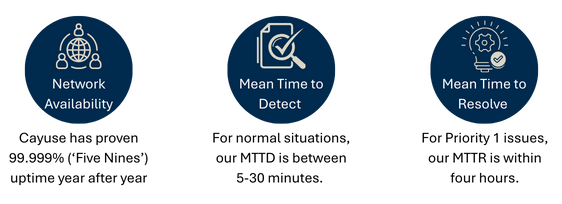
General rule of thumb: For shorter MTTD and MTTR windows, businesses need to invest accordingly. For example, purchasing redundant equipment and configuring proper failover can significantly reduce MTTR. Similarly, increasing staff coverage enables faster detection and response to critical issues. Ultimately, the level of investment directly impacts the speed and effectiveness of incident management.
Building Resilience
Every second of uptime matters. A NOC transforms IT from a vulnerability into a competitive advantage. Organizations that invest in this capability position themselves to weather disruptions, defend against evolving threats, and maintain the trust of customers and partners.
The bottom line is simple: downtime is costly, but foresight is priceless. A well-managed NOC delivers the IT resilience and reliability modern businesses demand - because in today’s digital economy, stability isn’t optional; it is the foundation of success.
Don’t let downtime dictate your business outcomes. Partner with Cayuse to strengthen your IT backbone and protect your operations from costly disruptions. Contact us today to learn how we deliver stability, security, and peace of mind.