
In a distributed work environment, technology is more than a background function. It is the infrastructure your people rely on to think, communicate, and execute. Yet many organizations still treat IT support as something they simply have, rather than something they intentionally design.
When support is treated this way, the damage is rarely dramatic. More often it shows up quietly: stalled workflows, repeated interruptions, frustrated employees, and growing exposure to preventable security issues. Work still happens, but it happens with friction. Over time, that friction becomes a tax on productivity and a drain on confidence in the systems people use every day.
This is particularly true for mid-sized organizations that are scaling operations, supporting distributed teams, and relying on IT without the depth of internal resources found in larger enterprises. It is important for leaders to recognize the gaps and diagnose where work is breaking down. Doing so will lead to evaluation of whether the current IT support model is built appropriately.
The Core Problem
Most organizations evaluate IT support based on tickets, tools, or headcount. Employees experience something different. They experience momentum or delay. Clarity or confusion. A fast return to work or repeated detours.
That difference matters because the service desk is one of the few operational functions that touches every employee, every department, and nearly every workflow. When support quality declines, the effect spreads. It does not stay contained in IT. This is why weak support rarely remains an IT problem. Over recent years, it has become a workforce problem.
Two pressures are making this harder to ignore. First, work has become more distributed across time zones, devices, and software. When a key system fails or access breaks, employees do not have a simple fallback. Second, the expectations around security and availability continue to rise, even for mid-sized organizations. Support gaps that used to be inconvenient can now create business risk. The result is a familiar pattern: small issues linger, workarounds become permanent, and teams learn to lower expectations. Over time, this affects more than efficiency. It shapes how work gets done and what teams come to accept as normal. That is not a culture issue, it is a design issue.
Warning Signs
The challenge with weak IT support is that it rarely presents as a single, obvious failure. Most often, issues are recognized in hindsight because the work continues, systems function “well enough”, and from a distance, everything appears intact. The interruption only becomes visible at the individual level, in how work is experienced day to day.
When support is inconsistent or not aligned to how your organization operates, small inefficiencies begin to accumulate. Over time, those inefficiencies become patterns that are easy to overlook but difficult to reverse.
If you are unsure whether support is quietly affecting performance, look for these signals:
- Resolution times vary widely, even for routine issues
- The same problems resurface without a clear path to reduction
- Employees rely on workarounds instead of trusting the system
- Communication from support is inconsistent or unclear
- Coverage exists, but not when and where work is actively happening
These are not isolated inconveniences. They point to a mismatch between the support model and the pace, structure, and expectations of the business. Left unaddressed, these issues do not remain static. They compound, making it harder to scale operations, maintain consistency, and respond effectively to growth or disruption.
What High Performance Support Looks Like
Leaders often equate “better support” in terms of speed or tools, such as faster ticket closure or a new platform. In practice, the most meaningful improvements come from how support is structured, not just how quickly issues are resolved.
A simple way to evaluate your current service approach is to ask questions that focus on the employee experience and the operating discipline behind it, such as:
- Do employees know exactly how to get help, and what will happen next?
- Is coverage adequately aligned to include varied time zones and peak periods?
- Are repeat issues being analyzed, documented, and reduced over time?
- Does support feel calm and clear, or rushed and fragmented?
- Are maintenance and updates planned in advance, or mostly reactive?
These questions do not require deep technical knowledge, but they do reveal whether your service structure is designed for reliability or held together by effort. This is where the distinction becomes clear: support quality extends beyond responsiveness alone. More importantly, it includes how deliberately the structure is designed and governed.
The Role of the Service Desk in Efficiency
Many organizations focus on what a service desk does. Fewer examine how it changes the way work moves across the organization. A service desk is much more than a help function. When it is designed well, it becomes a stabilizing layer between the complexity of modern systems and the people trying to do their jobs.
In practical terms, a mature service desk improves workforce efficiency by doing a few things consistently:
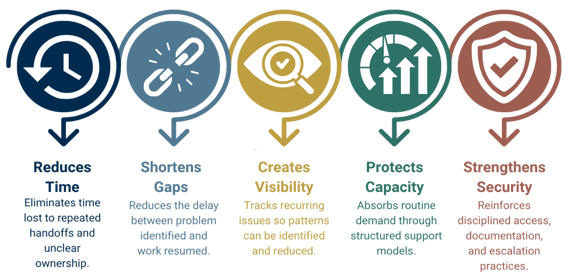
The difference is not the volume of support, but the structure behind it.
Learn more about the ways your business and your workforce can benefit from a tailored IT solution. We are here to help you and your team thrive!
Choosing the Right Path
If you see signs of friction, you usually have three viable paths. Each has tradeoffs that leaders should name early.
Option 1: Reset internally
This works when you have stable staffing and leadership bandwidth to redesign workflows, clarify ownership, and build consistent quality controls. The risk is that the work competes with daily escalation pressure, so progress can stall.
Option 2: Build a hybrid approach
Many organizations keep higher tier expertise internal and hand off Tier 1 support or extended hours coverage. This can reduce burden quickly, but it requires clear governance and defined handoffs. Without those, complexity can increase.
Option 3: Partner with a managed services provider
This can provide consistent coverage, training discipline, and structured quality management without adding internal headcount. The tradeoff is that leadership must set clear success criteria up front. Without a shared definition of “good,” even a capable provider can be measured inconsistently.
Across all three paths, the common failure pattern is the same: leaders try to fix support symptoms without defining what stability, quality, and visibility should look like first.
Turning Insight Into Action
If you want a quick way to pressure test your current environment, start here. These questions tend to surface the real constraints quickly.
- Where does work slow down most often, and how quickly does it recover?
- Which issues repeat, and who owns the reduction of those repeat drivers?
- How often does leadership time get pulled into escalations that should follow a defined path?
- What do employees say about support when they are not filing a complaint?
- If ticket volume doubled next quarter, what would break first: staffing, workflow, or clarity?
As a first step, review a short window of recent issues and track how long work actually takes to return to normal, versus just when tickets are closed. This often reveals where delays persist beneath the surface.
Organizations that address this early improve support. Moreso, however, they remove drag from day-to-day work. By creating a more predictable, resilient environment for their teams, work moves with less interruption, and leadership attention can remain focused on higher-value priorities.
If this is a concern in your organization, rather than rushing into a solution, the goal should be to define what stable, consistent support should look like for your workforce. After that, you can then evaluate whether your current structure can deliver it.
This is where a structured evaluation becomes useful. At Cayuse, we see that service desk performance goes beyond a reflection of the tickets submitted. It is based around the functionality and appropriateness of the operating model and workforce. Leaders usually do not need more noise. They need a clear definition of “good,” a way to spot fragility early, and a low-risk path to improve support without creating disruption.
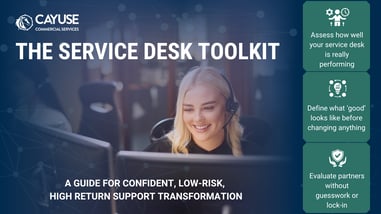
For more insight into understanding how your IT support is affecting workforce productivity, download The Service Desk Toolkit. It provides executive decision framework for evaluating service desk performance, governance, and safe improvement paths without requiring deep technical process knowledge. There is no obligation. Simply download the toolkit and apply the framework to your environment. The results will guide you toward the most appropriate IT solution for your organization.